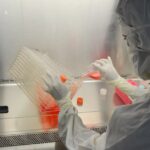
Singapore’s Sky Greens vertical farm just achieved what food experts deemed impossible five years ago: producing lab-grown chicken at $12 per pound while growing vegetables in the same facility. The 40-story agricultural tower in Marina Bay harvested its first commercial batch of cultivated meat in January 2026, marking a watershed moment for food production.
The breakthrough eliminates the need for separate facilities, cutting production costs by 60% compared to traditional lab-grown meat operations. Consumers can now buy Singapore-grown chicken and bok choy from the same vertical farm, both produced without soil, pesticides, or animal slaughter.

## Multi-Level Production Changes Everything
Sky Greens’ revolutionary approach dedicates floors 1-15 to vegetable cultivation, floors 16-35 to cellular agriculture bioreactors, and floors 36-40 to processing and packaging. This vertical integration slashes operational costs and creates unprecedented efficiency gains.
The facility produces 2,000 pounds of lab-grown chicken daily alongside 15,000 pounds of vegetables. Chief Operating Officer Dr. Mei Lin Chen reports production costs dropped from $50 per pound in 2024 to $12 per pound today, making cultivated meat competitive with premium organic chicken.
“We’re using the same climate control, power grid, and water recycling systems for both operations,” Chen explains. “The vegetables provide oxygen for the bioreactors, while the cellular agriculture produces CO2 that feeds plant growth. It’s a closed-loop system.”
The integration extends beyond infrastructure. Nutrient-rich water from vegetable cultivation, after filtration, feeds the cell culture medium. Food waste from vegetable processing becomes compost for organic fertilizer production sold to traditional farms.

## Technology Stack Drives Cost Reduction
The facility employs next-generation bioreactors manufactured by Netherlands-based CellTech Solutions, each capable of producing 50 pounds of meat weekly. These 500-liter vessels cost $80,000 each compared to $200,000 for previous models, making large-scale deployment economically viable.
Advanced AI monitoring systems track temperature, pH levels, and nutrient concentrations across all 200 bioreactors simultaneously. The proprietary software, developed in partnership with Singapore’s Nanyang Technological University, predicts optimal harvest times with 94% accuracy.
The breakthrough came from reducing growth medium costs by 70%. Traditional lab-grown meat requires expensive fetal bovine serum, but Sky Greens developed a plant-based alternative using proteins extracted from their own vegetable production. This innovation cuts raw material costs from $400 per batch to $120 per batch.
Solar panels covering the facility’s exterior generate 2.5 megawatts of power, meeting 80% of energy needs. Battery storage systems ensure uninterrupted operation during cloud cover, while excess power sells back to Singapore’s national grid.
## Market Response Exceeds Expectations
FairPrice, Singapore’s largest supermarket chain, launched exclusive sales of Sky Greens’ lab-grown chicken in 300 stores nationwide in February 2026. Initial projections estimated 1,000 pounds weekly sales, but actual demand reached 5,000 pounds in the first month.
Consumer acceptance surveys show 78% of buyers plan repeat purchases, citing taste quality and environmental benefits. The chicken, branded as “Pure Harvest,” sells for $18 per pound compared to $25 per pound for imported organic chicken and $8 per pound for conventional poultry.
Restaurant partnerships expand rapidly. Michelin-starred chef Andre Chiang features Pure Harvest chicken in his tasting menu at Restaurant Andre, while McDonald’s Singapore plans limited-time offerings starting June 2026. The fast-food giant’s trials in three locations sold out within hours.
Export licenses approved for Malaysia, Thailand, and Hong Kong position Sky Greens for regional expansion. The company projects $500 million revenue by 2028, with plans for similar facilities in Bangkok and Kuala Lumpur already approved.

## Investment Wave Follows Success
Sky Greens’ success triggered $2.3 billion in venture capital investment across Southeast Asia’s vertical farming sector in early 2026. Temasek Holdings led a $400 million Series C funding round for the company, valuing it at $1.8 billion.
Competitor facilities under construction include Bangkok’s AeroFarm Tower (30 stories, opening late 2026) and Manila’s GrowUp Vertical (25 stories, targeting 2027 launch). Each incorporates lessons learned from Singapore’s pioneering model while adapting to local market preferences.
The Singapore government announced $1 billion in additional support for food technology development through 2030, including tax incentives for companies achieving cost parity with conventional agriculture. This policy framework positions the city-state as the global hub for next-generation food production.
## Scaling Challenges Remain Significant
Despite early success, vertical farming faces substantial hurdles for global adoption. Construction costs average $50 million per facility, requiring significant capital investment and long payback periods. Energy consumption remains 30% higher than traditional farming when including artificial lighting and climate control.
Regulatory approval processes vary dramatically across markets. While Singapore’s streamlined framework enabled rapid deployment, European Union approval for lab-grown meat imports could take 2-3 years. United States FDA approval remains pending for most cultivated meat products.
Technical challenges persist around scaling cell culture production. Current bioreactor technology limits individual facility capacity to 700,000 pounds annually, requiring multiple locations to serve major metropolitan markets. Research continues on larger-scale bioreactors, but commercial availability won’t occur before 2028.
Singapore’s vertical farming revolution proves lab-grown meat production at commercial scale is no longer science fiction. The $12 per pound price point brings cultivated protein within reach of middle-class consumers, while vertical integration creates sustainable competitive advantages. Success here will determine whether this model transforms global food production or remains a high-tech niche solution.